
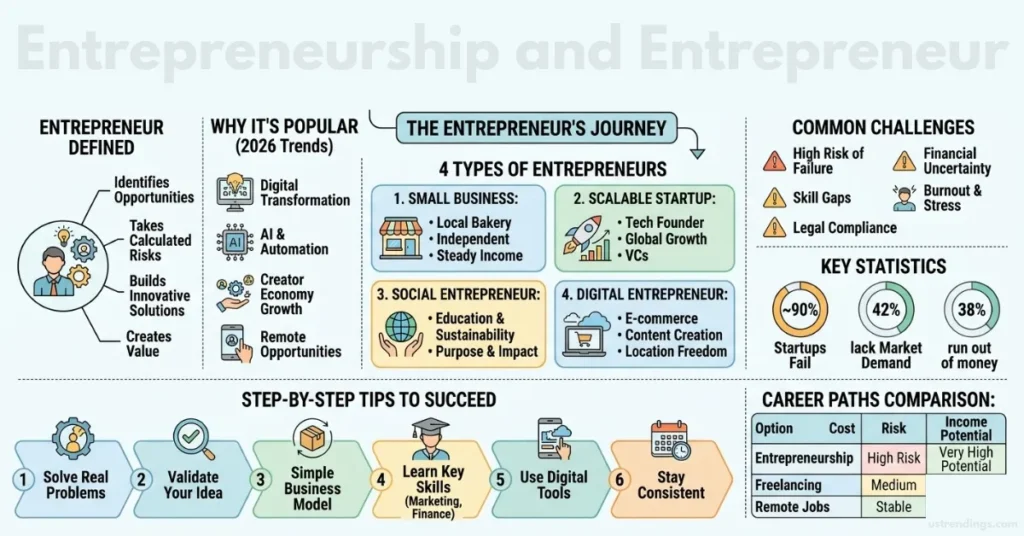
Entrepreneurship and Entrepreneur are not only buzzwords, but the driver of innovation, wealth creation, and the world changes. But what is entrepreneurship? Why do entrepreneurs succeed, and is entrepreneurship the right way to live? These are questions that are not clear to many.
And always wondered why:
- And what is it like being an entrepreneur in the first place?
- What is real-life entrepreneurship?
- What are the better risks, rewards, and alternatives?
You’re in the right place. This guide will equip you with easy, practical, and hands-on knowledge that you will be expected to possess to be able to know entrepreneurship, and take the next step with confidence.
What Is Entrepreneurship and Entrepreneur?
Entrepreneurship Defined
Entrepreneurship refers to the act of developing, innovating, and running a business enterprise to generate profit while addressing real-life challenges.
Who Is an Entrepreneur?
An entrepreneur is a person who:
- Identifies opportunities
- Takes risks
- Builds innovative solutions
- Creates value in the market
Why It Became So Popular
Entrepreneurship has exploded globally due to:
- Digital transformation (online businesses, AI, SaaS)
- Remote work opportunities
- Social media influence
- Low startup costs compared to traditional businesses
Today, anyone with a laptop and internet can become an entrepreneur.
Types of Entrepreneurs
Learning about the various secrets of entrepreneurs allows you to find out which direction is the best fit for your objectives, abilities, and risk-taking abilities. The journey of all entrepreneurs is not the same- some are oriented towards innovation, others are oriented towards stability.
1. Small Business Entrepreneurs
These are the most common types of entrepreneurs.
They run:
- Local shops
- Restaurants
- Freelance services
Best for: People who want a steady income and independence
Example: A local bakery owner or freelance designer
2. Scalable Startup Entrepreneurs
These entrepreneurs aim to build high-growth companies that can expand globally.
They:
- Seek investors
- Focus on innovation
- Build tech-driven solutions
Best for: Visionaries aiming for massive growth
Example: Tech startup founders
3. Social Entrepreneurs
They focus on solving social or environmental problems rather than just making a profit.
They work on:
- Education
- Healthcare
- Sustainability
Best for: People driven by purpose and impact
Example: Non-profit founders
4. Digital Entrepreneurs
They build businesses online using digital platforms.
Common models:
- Blogging
- E-commerce
- YouTube
- SaaS
Best for: People who want location freedom
Example: Online store owners or content creators
Common Problems & Challenges in Entrepreneurship
While entrepreneurship sounds exciting, it comes with real challenges.
1. High Risk of Failure
Most startups fail due to:
- Poor planning
- Lack of demand
- Financial mismanagement
2. Financial Uncertainty
Unlike jobs, income is not guaranteed.
3. Skill Gaps
Many beginners lack:
- Marketing skills
- Financial knowledge
- Business strategy
4. Burnout & Stress
Entrepreneurs often work long hours under high pressure.
5. Legal & Compliance Issues
Different countries have:
- Tax laws
- Business registration requirements
- Licensing rules
Ignoring these can lead to serious problems.
Data & Statistics on Entrepreneurship
- Around 90% of startups fail, showing how risky entrepreneurship can be.
- Nearly 20% of new businesses fail within the first year.
- About 50% survive 5 years, but only 30% last 10 years.
- The top reason for failure (42%) is lack of market demand.
- Around 38% fail due to running out of money.
- Less than 1% of startups become billion-dollar companies (unicorns).
Key Insight:
Entrepreneurship is high-risk but rewarding. Success depends on solving real problems, managing money, and staying adaptable.
Step-by-Step Tips to Succeed in Entrepreneurship
Tip #1: Start with Problem-Solving
Focus on solving real problems instead of chasing money.
Example:
People need faster food delivery → build a delivery service.
Tip #2: Validate Your Idea First
Before investing:
- Test your idea
- Ask potential customers
- Run small experiments
Tip #3: Build a Simple Business Model
Avoid complexity. Start with:
- One product/service
- One audience
- One clear goal
Tip #4: Learn Essential Skills
Key skills every entrepreneur needs:
- Marketing
- Sales
- Communication
- Financial management
Tip #5: Use Digital Tools
Leverage:
- Website builders
- Automation tools
- AI tools
These reduce cost and increase efficiency.
Tip #6: Stay Consistent & Adapt
Entrepreneurship is a long-term game.
Adapt to changes and keep improving.
Top Alternatives to Entrepreneurship
Not everyone needs to start a business. Here are powerful alternatives:
1. Freelancing
- Work independently
- Offer skills like writing, design, and coding
Best for: Beginners with skills
2. Remote Jobs
- Stable income
- Work from anywhere
Best for: Work-life balance
3. Investing
- Earn passive income
- Stocks, crypto, real estate
Best for: Long-term wealth
4. Franchising
- Use an established brand
- Lower risk than startups
Best for: Safer business entry
5. Side Hustles
- Start part-time
- Low risk
Best for: Testing entrepreneurship
6. Content Creation
- YouTube, blogging, social media
Best for: Personal branding
7. Consulting
- Sell expertise
Best for: Experienced professionals
Comparison Table: Best Career Paths
| Option | Cost | Risk Level | Income Potential | Best For |
| Entrepreneurship | Medium–High | High | Very High | Risk-takers & innovators |
| Freelancing | Low | Medium | Medium–High | Skilled individuals |
| Remote Jobs | Low | Low | Stable | Job security seekers |
| Investing | Medium | Medium | High (long-term) | Wealth builders |
| Franchising | High | Medium | High | Safer business owners |
| Side Hustles | Low | Low | Medium | Beginners |
Real Examples of Entrepreneurs
- Elon Musk – Founded Tesla and SpaceX, pursuing innovation and long-term vision.
- Jeff Bezos transformed Amazon into a large e-commerce company out of a small bookstore.
- Mark Zuckerberg – Founded Facebook, which has revolutionized social networking around the world.
- MrBeast built a giant online enterprise as a content producer.
- Muhammad Yunus– Introduced microfinance to alleviate poverty in the world.
Main Lesson:
Problems are solved by successful entrepreneurs; they take risks and think long-term.
Future of Entrepreneurship (2026 & Beyond)
The future of entrepreneurship is changing at a very high pace:
Key Trends:
- AI-powered businesses
- Digital products (courses, SaaS)
- Remote-first startups
- Creator economy growth
- Sustainable & eco-friendly ventures
Business people who embrace technology will prevail.
FAQ’s
What is the difference between entrepreneurship and entrepreneur?
Entrepreneurship is the process of building a business, while an entrepreneur is the person who starts and runs it.
Is entrepreneurship risky?
Yes, it involves financial and operational risks, but it also offers high rewards.
Can anyone become an entrepreneur?
Yes, with the right mindset, skills, and consistency, anyone can start.
What skills are needed for entrepreneurship?
Key skills include marketing, communication, leadership, and financial management.
Is entrepreneurship better than a job?
It depends on your goals. Entrepreneurship offers freedom and high income potential, while jobs provide stability.
Conclusion
Entrepreneurship and Entrepreneur are strong terms that influence the development of innovation and economic growth across the globe. The risks taken in the journey are many, but the rewards, freedom, impact, and financial growth are beyond reproach.
When you are starting:
- Begin small
- Learn continuously
- Take calculated risks
The most appropriate one is the one that is in harmony with your objectives and way of life.