
The use of AI search engine optimization tools is changing how websites are ranked, how content is produced, and how people find information. Old-fashioned SEO used to be based on manual keyword research, backlinking, and on-page optimization.
Today, AI-based systems study intent, context, and semantic relationships at scale, making SEO a lot more predictive and data-driven.
In case you are attempting to comprehend AI SEO tools described in a manner that is relevant to the current Search Generative Experience (SGE) of Google, the scope of this guide will offer you some professional-level dissection.
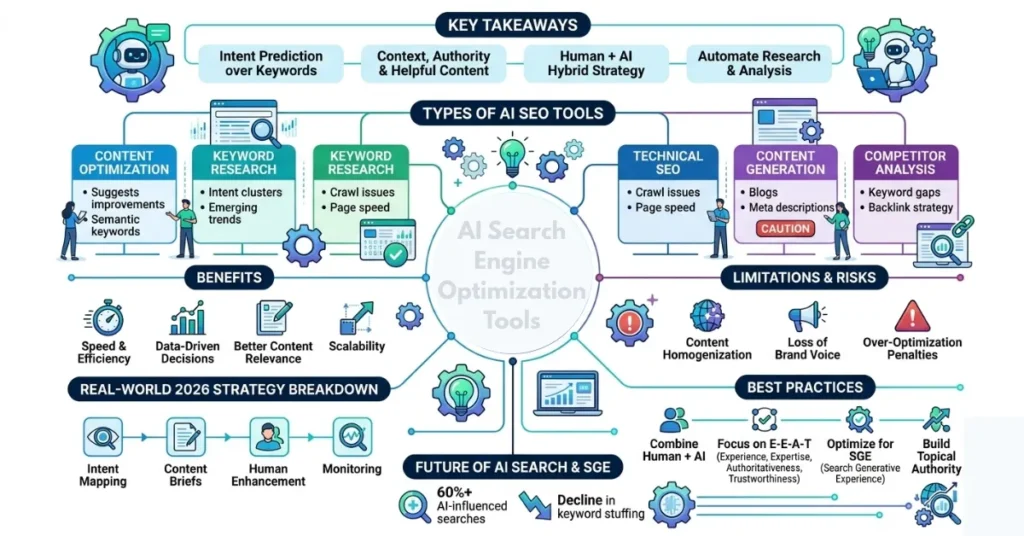
Key Takeaways
- AI tools transform SEO into intent prediction instead of targeting a keyword.
- Context, authority, and helpful content are the priorities of Google.
- AI SEO software automates research, optimization, and analysis.
- Excessive use of AI can diminish originality and rankings.
- Human + AI (hybrid strategy) is most effective in 2026.
What Are AI Search Optimization Tools?
They are machine learning-based and natural language processing (NLP) software platforms that assist in optimizing websites automatically or semi-automatically.
These tools analyze:
- Search intent
- Content structure
- Competitor strategies
- Ranking signals
- User behavior patterns
Unlike traditional SEO tools, AI Search Engine Optimization Tools strategy doesn’t just give data—they generate insights and even content recommendations in real time.
How AI SEO Tools Work
To fully understand AI SEO tools explained, you need to look at their core technologies:
1. Natural Language Processing (NLP)
AI understands how humans write and search. It identifies semantic meaning rather than exact keywords.
2. Machine Learning Models
These models learn from:
- Search engine updates
- User behavior
- Ranking patterns
3. Predictive Analytics
AI predicts:
- Which keywords will trend
- What content will rank
- How users will interact
4. Automation Engines
Tasks like:
- Content optimization
- Technical audits
- Internal linking
are automated with high accuracy.
Types of AI Search Engine Optimization Tools
1. AI Content Optimization Tools
These tools analyze top-ranking pages and suggest improvements.
Features:
- Keyword density optimization
- Semantic keyword suggestions
- Readability improvements
2. AI Keyword Research Tools
They go beyond volume and competition.
They identify:
- Search intent clusters
- Long-tail opportunities
- Emerging trends
3. AI Technical SEO Tools
These tools scan websites for:
- Crawl issues
- Indexing problems
- Page speed bottlenecks
4. AI Content Generation Tools
They assist in:
- Blog writing
- Meta descriptions
- Content briefs
Important: These should be used carefully to maintain originality.
5. AI Competitor Analysis Tools
They reveal:
- Competitor keyword gaps
- Backlink strategies
- Content weaknesses
Benefits of Using AI Search Engine Optimization Tools
1. Speed & Efficiency
AI reduces hours of work into minutes.
2. Data-Driven Decisions
No guesswork—only insights backed by data.
3. Better Content Relevance
AI ensures your content matches user intent.
4. Scalability
You can optimize hundreds of pages at once.
Limitations & Hidden Risks (Contrarian Insight)
Here’s something most guides won’t tell you:
AI search engine optimization tools can actually hurt your rankings if overused.
Why?
- Content Homogenization
AI tools often produce similar outputs. This leads to:
- Duplicate-style content
- Lack of uniqueness
- Loss of Brand Voice
AI-generated content can feel generic and less trustworthy. - Over-Optimization Penalties
Too much optimization can trigger search engine filters. - False Confidence in Data
AI predictions aren’t always accurate.
Expert Insight:
The real competitive advantage in 2026 is not using AI—it’s using AI differently than everyone else.
Real-World Use Case (2026 Strategy Breakdown)
Scenario:
A niche blog targeting “AI tools for search optimization”
Step-by-Step Strategy:
- Intent Mapping
Cluster keywords based on:
- Informational intent
- Commercial intent
- AI Content Brief Creation
Use AI to generate:
- Headings
- FAQs
- Semantic keywords
- Human Content Enhancement
Add:
- Personal insights
- Case studies
- Unique data
- On-Page Optimization
Optimize:
- Title tags
- Internal links
- Content structure
- Performance Monitoring
Track:
- Rankings
- CTR
- Engagement
Placeholder: [Link to Recent 2026 Study]
How to Choose the Right AI SEO Tool
Key Factors:
1. Accuracy
Does it provide reliable recommendations?
2. Ease of Use
User-friendly interface matters.
3. Integration
Can it connect with your CMS or analytics tools?
4. Customization
Can you adjust outputs based on your strategy?
Pro Tip:
Avoid tools that promise “instant #1 rankings.”
SEO is still a long-term game—even with AI.
Best Practices for AI-Driven SEO
1. Combine Human + AI Intelligence
Use AI for data, humans for creativity.
2. Focus on E-E-A-T
- Experience
- Expertise
- Authoritativeness
- Trustworthiness
3. Optimize for SGE (Search Generative Experience)
To rank in AI-generated answers:
- Answer questions clearly
- Use structured headings
- Provide concise summaries
4. Build Topical Authority
Cover topics deeply instead of targeting isolated keywords.
5. Continuously Update Content
AI favors fresh, relevant information.
The Future of AI Search & SGE
Search engines are moving toward:
- Conversational queries
- Personalized results
- AI-generated summaries
This means:
Ranking is no longer just about keywords
It’s about being the best answer
Prediction for 2026–2028
- 60%+ searches influenced by AI summaries
- Increased importance of structured content
- Decline in traditional keyword stuffing
[Specific Stat Placeholder]
FAQ’s
What are AI Search Engine Optimization Tools?
AI Search Engine Optimization Tools are software platforms that use AI to automate and enhance SEO tasks like keyword research, content optimization, and analytics.
Are AI SEO tools worth it?
Yes, but only when combined with human expertise. AI alone cannot replace strategic thinking.
Can AI tools replace SEO experts?
No. AI supports SEO professionals but cannot replicate experience, creativity, and decision-making.
What is the best use of AI in SEO?
The best use is:
- Data analysis
- Content optimization
- Strategy support
Do AI tools help rank faster?
They improve efficiency, but rankings still depend on competition, authority, and content quality.
Conclusion
The use of AI search engine optimization tools is changing the face of SEO by turning it into quicker, more intelligent, and more data-driven. The true success, however, lies in the fusion of AI advice and human imagination and skills.
Optimization of search using AI tools will not remove your strategy, but rather improve it, and you will be able to keep up with the changing world of search.