
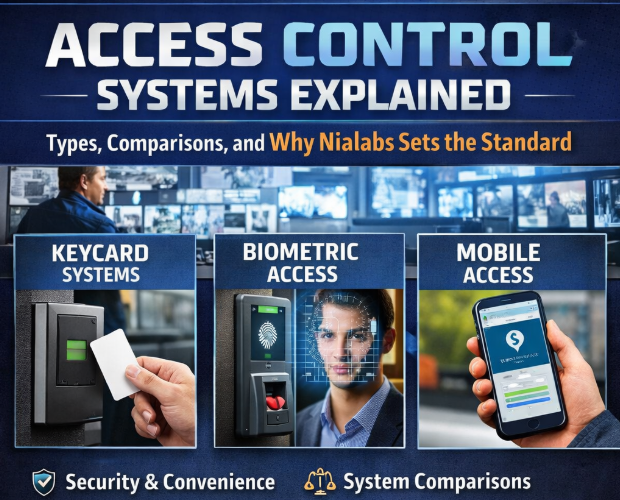
Access Control Is the First Line of Defense
Unauthorized access is no longer a minor inconvenience — it is a direct threat to safety, data integrity, and business continuity. From corporate offices and hospitals to data centers and smart campuses, organizations are under constant pressure to control who enters, when they enter, and what they can access.
This is where access control systems become critical. A modern access control system does far more than lock and unlock doors. It enforces policy, prevents breaches, ensures compliance, and creates accountability.
In this guide, we’ll break down the main types of access control systems, compare their strengths and weaknesses, and explain how the Nialabs Access Control System delivers a powerful, future-ready solution for both physical and logical security.
What Is an Access Control System?
An access control system is a security framework that regulates entry to physical locations, digital resources, or both. Instead of relying on traditional keys or shared passwords, access control systems use identity verification and permission rules to decide whether access should be granted or denied.
At its core, access control answers three critical questions:
- Who are you? (Authentication)
- What are you allowed to access? (Authorization)
- When and under what conditions? (Policy enforcement)
Modern solutions like the Nialabs Access Control System unify these elements into a centralized platform, enabling organizations to maintain strict control without sacrificing usability.
Why Access Control Systems Matter More Than Ever
Today’s security challenges are complex and evolving. Organizations face:
- Insider threats
- Tailgating and unauthorized physical entry
- Credential theft
- Compliance and audit failures
- Remote and hybrid work environments
Without a robust access control system, these risks multiply quickly.
A well-designed access control system:
- Prevents unauthorized access
- Reduces human error
- Improves audit readiness
- Enhances operational efficiency
- Scales as the organization grows
Types of Access Control Systems
Understanding the different access control models is essential for choosing the right solution.
1. Discretionary Access Control (DAC)
Discretionary Access Control allows the owner of a resource to decide who can access it. This model is commonly found in basic operating systems and small file-sharing environments.
Advantages
- Easy to implement
- Highly flexible
- Minimal administrative overhead
Disadvantages
- Weak security
- High risk of privilege abuse
- Poor scalability
Best Use Case
DAC is suitable only for low-risk, non-critical environments. It is not recommended for enterprises or regulated industries.
2. Mandatory Access Control (MAC)
Mandatory Access Control enforces access based on strict security classifications defined by a central authority. Users cannot change permissions under any circumstances.
Advantages
- Extremely high security
- Strong resistance to insider threats
- Ideal for sensitive data environments
Disadvantages
- Very rigid
- Complex to manage
- High implementation cost
Best Use Case
MAC is typically used in military, government, and classified environments where security outweighs flexibility.
3. Role-Based Access Control (RBAC)
Role-Based Access Control assigns permissions based on job roles rather than individuals. This model is widely used across enterprises due to its balance between security and usability.
Advantages
- Scalable and structured
- Simplifies onboarding and offboarding
- Reduces administrative errors
Disadvantages
- Can lead to “role explosion” if poorly designed
- Limited contextual awareness
Best Use Case
RBAC is ideal for corporate offices, healthcare systems, and educational institutions.
The Nialabs Access Control System implements RBAC with centralized role management, ensuring consistent access policies across all locations.
4. Attribute-Based Access Control (ABAC)
Attribute-Based Access Control is the most advanced and flexible model. It evaluates multiple attributes in real time before granting access.
Attributes may include:
- User identity
- Location
- Time of day
- Device type
- Risk level
Advantages
- Highly granular control
- Context-aware decisions
- Perfect for Zero Trust architectures
Disadvantages
- Complex policy design
- Requires advanced management tools
Best Use Case
ABAC is best suited for cloud environments, smart buildings, and large organizations with dynamic security needs.
Nialabs enhances ABAC with intelligent policy engines that simplify complexity while maintaining precision.
Comparison of Access Control Models
| Model | Security | Flexibility | Scalability | Best Fit |
| DAC | Low | High | Low | Small, low-risk systems |
| MAC | Very High | Very Low | Medium | Government, military |
| RBAC | High | Medium | High | Enterprises |
| ABAC | Very High | Very High | Very High | Smart, cloud-first organizations |
Key Insight:
Most modern organizations benefit from a hybrid approach, combining RBAC and ABAC — a capability fully supported by the Nialabs Access Control System.
Physical vs Logical Access Control
Physical Access Control
Controls entry to physical locations such as:
- Offices
- Data centers
- Hospitals
- Campuses
Technologies include:
- Smart cards
- Biometric readers
- Mobile credentials
- PIN codes
Logical Access Control
Protects digital assets such as:
- Networks
- Applications
- Databases
A modern security strategy integrates both physical and logical access control into a single platform — exactly what Nialabs delivers.
Why Choose the Nialabs Access Control System?
The Nialabs Access Control System is designed for organizations that demand security, scalability, and simplicity.
Key Features
- Centralized access management
- Role-based and attribute-based control
- Real-time monitoring and logs
- Seamless integration with existing infrastructure
- Cloud-ready architecture
- Scalable for single sites or multi-location enterprises
What Sets Nialabs Apart
- Intelligent policy enforcement
- User-friendly administration
- Future-proof design
- High reliability and performance
Nialabs doesn’t just control access — it creates a secure ecosystem where people, data, and infrastructure work together safely.
Common Access Control Mistakes Organizations Make
- Granting excessive permissions
- Failing to revoke access after role changes
- Using outdated access technologies
- Ignoring audit trails
- Treating access control as a one-time setup
The Nialabs system actively helps prevent these mistakes through automation, visibility, and policy enforcement.
Frequently Asked Questions (FAQ)
What is the most secure access control model?
MAC offers maximum rigidity, but ABAC provides the best balance of security and flexibility in modern environments.
Is RBAC enough for large organizations?
RBAC is strong, but combining it with ABAC — as Nialabs does — delivers superior control.
Can access control systems prevent insider threats?
Yes. With least-privilege access, monitoring, and logging, systems like Nialabs significantly reduce insider risk.
Do small businesses need access control systems?
Absolutely. Even basic access control dramatically improves security and accountability.
Conclusion: Secure Access Starts with the Right System
Access control is no longer optional — it is foundational to modern security. Choosing the right model and platform determines how effectively an organization can protect its people, assets, and data.
By combining advanced access control models, centralized management, and intelligent policy enforcement, the Nialabs Access Control System stands out as a powerful, future-ready solution.