
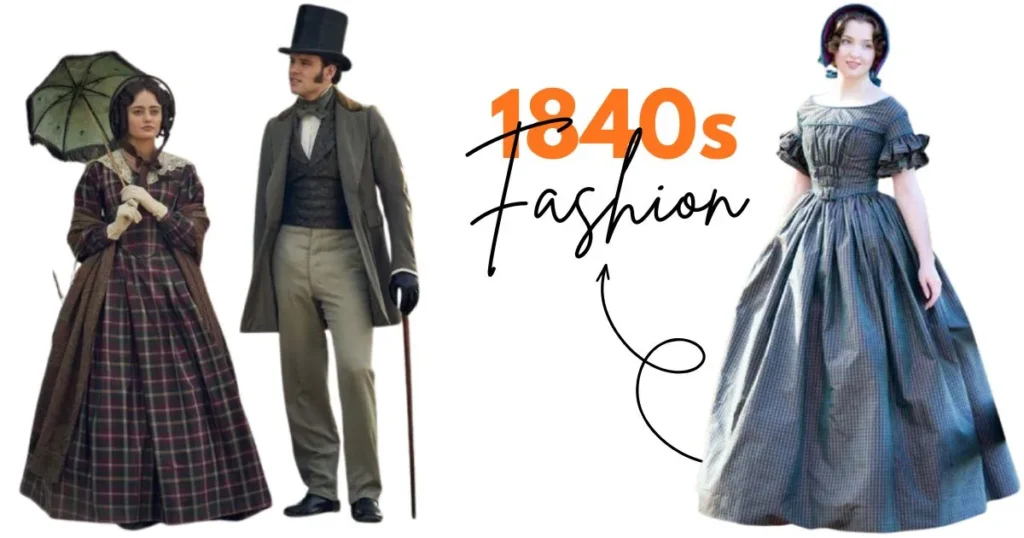
The 1840s fashion is one of the most interesting times of the past, as the transition between the Regency style and the more exuberant Victorian styles. This decade was distinguished by a blend of simplicity, modesty and increased sophistication of clothing. It mirrored the social changes as a result of the industrial revolution, altered gender roles, and the impact of the royalty and aristocracy.
The Rise of Structured Fashion in the 1840s
At the beginning of the 1840s, there was a radical transformation of fashion compared to the loose styles of the last decades. The shift towards more fashionable and starched clothing was a sign of the growing role of formal apparel in both men’s and women’s fashion. It was a time when social status was evident in clothing and fashion was therefore a form of art as well as a means of social positioning.
The 1840s fashion of women was especially associated with the development of a tall and thin figure. The dressing was tight-fitting at the neck and had long sleeves and was modest. The skirt was broad but was underpinned by crinoline or petticoats, which gave it fullness but not overly exaggerated.
Tailored Clothing for Men
In the case of men, more customized suits emerged in the 1840s, and frock coats and waistcoats were the most important aspects of regular clothes. The frock coat was a knee-length garment with a tight waist and a full skirt; it became one of the wardrobe icons. This change was an indication of the transition to professional, formal clothes in our social life.
Men wore clothes that were characterized by a clean and sharp look in this period. Frock coats, waistcoats and cravats were mixed in a way that would enhance a smooth and proud look. The wearing of top hats and gloves adorned the style that was quite sophisticated in the 1840s.
Women’s Dresses: Modesty and Elegance
Dresses worn by women in the 1840s were meant to be modest. High necklines, long sleeves and structured bodices were a common thing and therefore the fashion of this period was very different than the previous decades of the 19th century. The purpose was to impress an elegant, refined appearance. Dresses are usually manufactured of luxurious materials like silk, satin, and velvet.
The dresses of elaborate nature, such as puffed sleeves, heavy lace collars, and decorations made out of ribbons, are witnessed during this period. These facts were providing the touch and the elegance and not losing the sense of austerity and decency, which were the primary attributes of the 1840s fashion.
The Influence of Queen Victoria on Fashion
The fact that Queen Victoria became a monarch in 1837 influenced the 1840s fashion. Being a classic icon, her personal style has dictated much of the decade. She was fond of understated, feminine fashions, which spread the trends in Britain and even wider in the more conservative dress code.
It was particularly the wedding dress of the Queen in 1840. Her white color makes it popular and this color became the norm for bridal dresses in the next decades. This event solidified the connection between style and the monarchy and afterward, the Victorian style has been linked with moderation and elegance.
Fabric Choices: The Materials of 1840s Fashion
The textile was an important element of the fashion of the 1840s, and the rich and fine fabrics became popular. Silk, satin, velvet, and wool were the materials that were mostly used to make clothing for men and women. This enabled elaborate designs and a luxurious look because such fabrics could be used to bring elaborate designs and opulence to the designs due to the obsession with sophistication at the time.
Besides the material, the fabrics used were dyed in dark and earthy colors. Both genders wore black, deep green and deep navy, as well as lighter shades such as pastels were worn on special occasions or during spring and summer dresses. These color options made the style of the time sophisticated and low-key.
The Role of Accessories in 1840s Fashion
The accessories played an essential role in the 1840s fashion, providing a certain individuality to a rather strict and strict wardrobe. Bonnets were the most significant accessory for women. These bonnets were frequently adorned with ribbons, lace, and flowers, forming a fancy appearance, without violating the modest style of fashion.
Men were, however, keen on accessories too. A man was made up of cravats, gloves, pocket watches and top hats. These accessories were not only used to complement the outfit but also depicted the wearer as a lover of attention and a well-socialized person.
Fashion and Social Class
Social class had a great impact on fashion in the 1840s. The aristocracy and the upper classes dictated the trends and their decisions were followed by the newer classes, known as the middle class people who aspired to copy the styles of the high classes. This opened up fashion trends to the many social strata and this was made easy by the increased industrial output.
The advent of mass production meant that more affordable clothes could be brought about. Although the richer classes were able to afford tailor-made clothes, the middle-class enjoyed the privilege of form of ready-made dressing earnestly representing the current styles of the new era. This democratization of fashion saw the start of more varied and less exclusive fashion trends.
The Industrial Revolution and Fashion
The industrial revolution has had immense changes that have been incorporated in the 1840s fashion. New machines were invented and the factories expanded, which meant that more clothing was produced in large quantities and became more affordable and accessible to many people. This made fashion more democratic, yet fashion supremacy was retained by the elite.
It was also during this time that new technologies were invented to manufacture fabrics such as wool, cotton, which were utilized in the manufacturing of a great variety of clothes. Availability of these materials made fashion expand beyond the rich as the middle class enjoyed the fashions promoted by high society.
Victorian Influence: The Foundation for Future Trends
The fashion of the 1840s established the basis of the more luxurious Victorian styles that would follow towards the later part of the century. This emphasis on modesty, structure and formality would carry on into the 1850s fashion and the fashion of the 1860s, but of finer design and ornamentation.
Just as the Victorian era’s early years were covered in restrained and formal styles, the next decades would be characterized by an outburst of rich fabrics, elaborate designs and elaborate outlines. The development of such fashion was the logical next step of those developments in the 1840s, since the role of fashion in society was only expanding.
Changing Trends in Men’s Fashion
The 1840s fashion of men also changed to a more formal and tailored appearance. The frock coat, waistcoat and cravat were in the center of a man’s wardrobe, which was a change to the less formal dressing of the previous years. The cravat was indeed significant since it was an early forerunner of the modern necktie and gave men the chance to do something unique by using dissimilar knotting patterns.
Men used top hats, gloves and pocket watches and this gave a touch of elegance to their dress code. The strictness of the fashion of the 1840s in men reflected the significance of professionalism in life in general and its role in the lives of men, which was increasing during this time.
The Influence of Art and Culture on 1840s Fashion
The 1840s fashion was heavily impacted by art and culture, through which paintings, literature, and theater contributed to the development of the popularity of the fashion among the people. Most paintings of the time tended to portray the fashion of the day, the affluence and the beauty of the high classes, and assist in determining the ideal fashion among both men and women.
Around the same period, the Romantic movement of art and literature characterized the 1840s, focusing more on the expression of emotions and beauty. The culture affected the fashion in which glamorous, detailed clothes were promoted, which focused more on elegance and sophistication. Writers and artists of the period helped in the process of creating a taste among the people, which had an imperceptible but huge influence in shaping the trends of fashion.
Fashion Innovations: The Birth of Mass Production
The start of in-house production of clothes was one of the greatest inventions of the fashion of the 1840s. The previous decade embraced ready-made clothes, unlike fashion, which was still done manually by tailors and seamstresses. The production of textiles and clothes on a mass scale meant that more citizens could afford to wear stylish clothes, though in a lower class compared to the high society.
This move to mass production not only increased access to fashion but also contributed to the innovation of clothes design and production. The boom of the fashion industry in the following decades was predetermined by the era when the growing number of people could afford to purchase stylish clothes of different quality and prices.
FAQ’s
What characterised the fashion of women in the 1840s?
The 1840s clothing of women was aimed at modesty; high collars, long sleeves and cut-in bodices. Most of the dresses were fashioned out of such extravagant fabrics as silk and velvet, and they gave a very sophisticated appearance.
What was the evolution of men’s fashion in the 1840s?
The fashion of men in the 1840s was more formal and customized and was dominated by the use of the frock coat, waistcoat, and cravat. The knee-length shape of the frock coat had become the focus of men’s clothing as their formal wear.
How did Queen Victoria impact 1840s Fashion?
The modest, feminine style of Queen Victoria significantly inspired the 1840s fashion, especially following her marriage in the year 1840, as she donned a white dress, thus becoming a benchmark in the wedding gowns ever since.
What was the impact of industrialization on the fashion of the 1840s?
The industrial revolution facilitated the possibility of mass production of textiles and garments and thus fashion became more accessible to many people and style democratized to the middle class.
Conclusion
In a conclusive way, the 1840s Fashion was an era shift in terms of dressing in the fusion of modesty and beauty. The age of rigorous, formal clothing became the predecessor of other fashion trends, which affected not only the Victorian period but also modern fashion. Fashion became more affordable with breakthroughs in the production of fabrics, mass production and changed the way the industry and society viewed fashion. The 1840s were an epochal event, and they show the grace and social changes of those times.